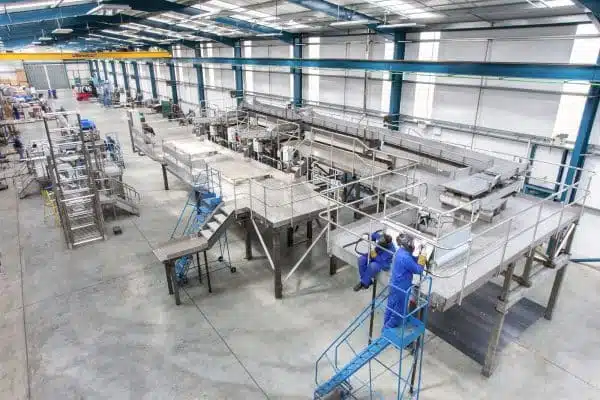


A food conveyor system is the full run of conveying between intake and packing, and it performs only as well as its weakest handover. Design one by writing the line as a sequence of stages, stating what each stage needs, then specifying the conveying for every gap between them. For most food lines that conveying backbone is vibratory, with other methods brought in only where a specific job demands them.
If you have been asked to add capacity or fix a bottleneck, the line probably works in pieces but not as a whole. The seasoner runs at rate yet starves what follows it, or a new extension will not fit the existing layout. This method works from the process backwards, so each conveyor is specified to solve a stage’s problem rather than to fill a gap in the drawing.
Map the process before you specify any conveyor
Start with a flow sheet, not a catalogue. List intake, preparation, conveying, seasoning, cooling and packing as separate boxes. Under each, note the rate it must receive and deliver, the condition the product must be in on leaving (whole, dry, cooled, coated) and how the stage gets cleaned. Where two stages meet, that is a handover, and it earns its own line on the sheet.
The sheet also survives later change. If an extension is likely, mark where a spur or second packing head would branch off and keep that position clear. Lines specified one machine at a time rarely have such a point, so the first extension means cutting into a running line. Ask any supplier for the flow sheet before discussing machines. One who only wants to sell a unit will not need it. One who does will show where their equipment sits in your sequence.
Intake and distribution: feeding the line at a steady rate
The intake sets the rate for everything downstream. When feed varies, the seasoner starves in the gaps and floods when supply catches up. Both look like lost throughput rather than a conveyor fault, which is why they are hard to trace on the floor.
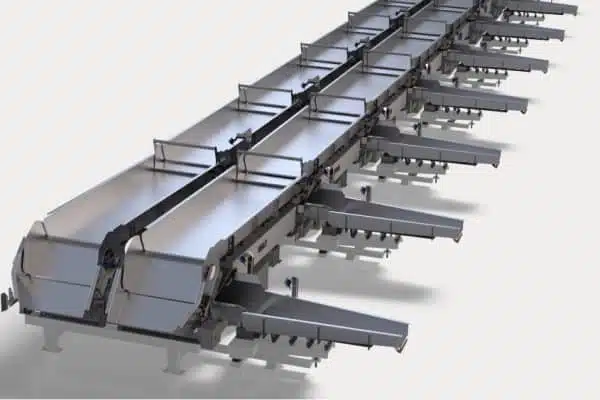
Distribution matters wherever one feed must split across several lines or stages. A vibratory distribution conveyor shares product across its outlets so each downstream stage sees the rate it was designed for. Check the split at part load as well as full flow. A division that balances at full supply can leave one branch short when the upstream rate drops. Hopper sizing and flow control need their own design step, so settle them before fixing conveyor lengths. Distribution options are on the distribution conveyors page.
Why vibratory conveying is the backbone of a food line
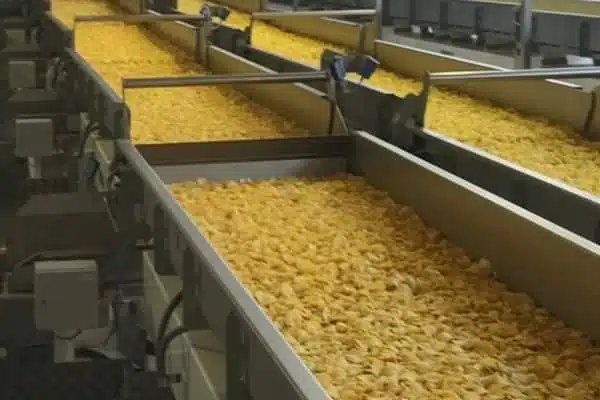
Vibratory conveyors earn the central role in food conveyor systems for three reasons. They move product gently, which matters for anything that can break, chip or lose its coating. Their flat, open beds are simple to clean, which matters everywhere hygiene is audited. And they give fine control over flow, which is what makes steady feed, splitting, grading and laning possible at all. The range of jobs they cover is on the vibrating conveyor systems page.
Other methods still have their places. Belt conveyors earn theirs on long straight runs and inclines, and air conveying covers routes a rigid conveyor cannot take. Treat them as connectors between vibratory zones rather than the spine of the line, and design every transfer between methods deliberately: set the drop height, match the speeds, and check how product lands. A transfer that suits a robust product can break a fragile one. Details for the supporting methods are on the belt conveyors page and the air conveying systems page.
The post-seasoning run: protecting the coating
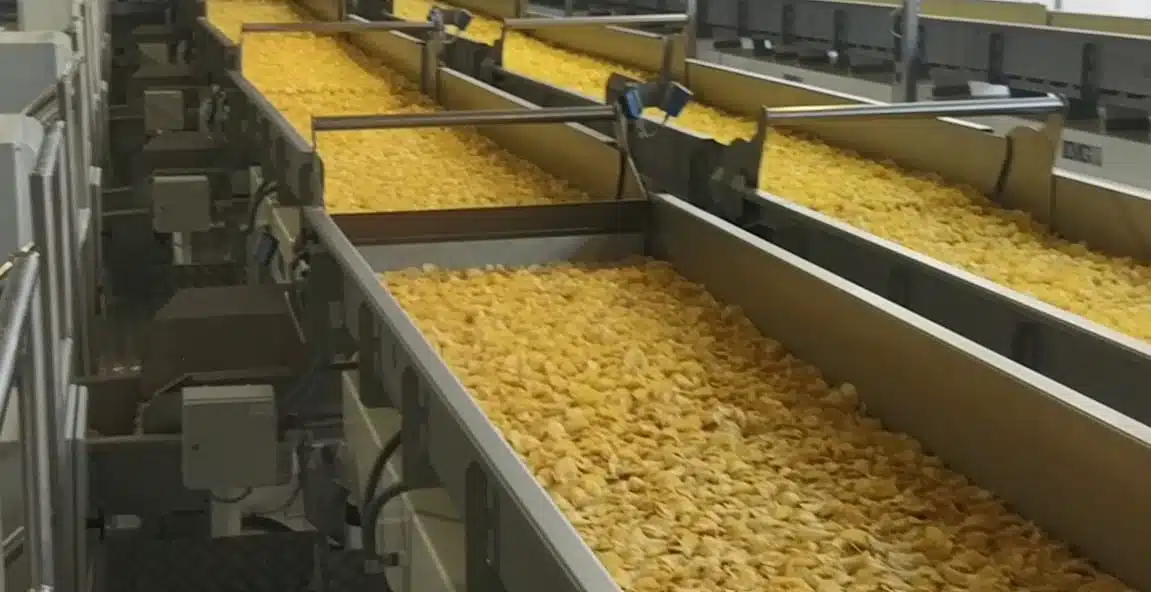
Seasoned product needs careful handling from seasoner through cooling to packing, and this stretch is where vibratory conveying proves its worth most clearly. A well-designed vibratory bed moves seasoned product without scrubbing the coating off it. The outcome depends on the detail: the bed, the speed, the settings for the product in question, and the transfer points at each end.
Treat the seasoner-to-pack run as one design problem and give it the same attention to gentle handling as to throughput. Check the bed against product shape, keep the drop from the seasoner short, and confirm product reaches the packing machine in the orientation it needs.
Hygiene across the whole system, not just each machine
Hygiene fails at the joins. A machine can be easy to clean on its own and still hold residue where its discharge meets the next conveyor, under a lip, or inside a chute nobody can open. Audit the joins as carefully as the machines.
For each transition, ask which surfaces touch food, how access points are reached for cleaning, and whether the routine for one section actually reaches the next. Where equipment from several suppliers meets, agree who owns the transition detail before drawings are final. That is usually where cross-contamination risk and extra cleaning time creep in. The construction of individual conveyors is covered in our food grade conveyor systems article, so use it as a reference and check the system-level joins here.
Throughput, layout and when to add elevating systems
Line throughput is set by the slowest balanced stage. A fast machine still loses time if the handover before it cannot deliver. Calculate the rate at every handover before committing to a layout, rather than relying on the rating of the largest machine.
Use elevating systems where floor space is tight or the process needs vertical movement, such as lifting product from a cooling level to a packing level. Then check the layout leaves room to grow: a clear route for a future branch, a spare outlet on the distribution, and access around any elevator for maintenance.
Next step before the layout is fixed
If you are planning a new line or fixing a bottleneck, send KMG your target throughput, your stage sequence and a rough floor plan. That lets design begin from the whole line rather than one machine. The food conveyor manufacturers page sets out how KMG approaches conveying work across a process. Do this while the layout can still move, because changes cost far less at the planning stage than after installation.