

In snack food manufacturing, seasoning accuracy is one of the most important factors in delivering a consistent product. When seasoning levels vary from batch to batch or even within the same production run, it affects taste, customer satisfaction, and profitability. Yet many manufacturers accept a level of inconsistency without fully understanding what drives it or how to fix it.
This article breaks down the key factors that influence seasoning accuracy and explains the practical steps you can take to improve it across your production line.
What Do We Mean by Seasoning Accuracy?
Seasoning accuracy refers to the ability of a system to apply the correct amount of flavouring to every piece of product, every time. It is measured by how closely the actual application rate matches the target, and how consistent that application is over time. A system with good accuracy will deliver tight tolerances with minimal variation, meaning fewer rejected batches, less wasted seasoning, and a product that tastes the same from the first packet to the last.
The Role of Product Flow
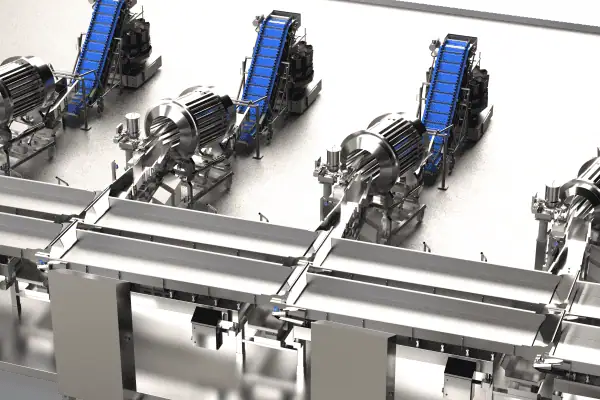
One of the biggest influences on seasoning accuracy is how evenly the product flows into the seasoning system. If the flow rate varies, the ratio of seasoning to product will fluctuate even if the dosing system itself is performing well. This is why the conveying equipment upstream of the seasoning drum matters just as much as the drum itself.
Vibratory conveyors with proportioning control can regulate the flow of product into the drum, creating a steady, even feed. Without this control, surges and gaps in the product stream will inevitably lead to over seasoned and under seasoned product.
Gravimetric vs Volumetric Dosing
There are two main approaches to seasoning dosing: volumetric and gravimetric. Volumetric systems dispense seasoning based on a fixed volume per cycle, which can work well when the seasoning flows consistently. However, if the powder density changes, clumps, or the ambient humidity shifts, the actual weight applied can drift significantly.
Gravimetric systems measure the actual weight of seasoning being dispensed in real time. This means they automatically compensate for changes in powder condition, delivering far more accurate and repeatable results. For manufacturers who need tight control over seasoning costs and product consistency, gravimetric dosing is the more reliable choice.
Drum Design and Retention Time
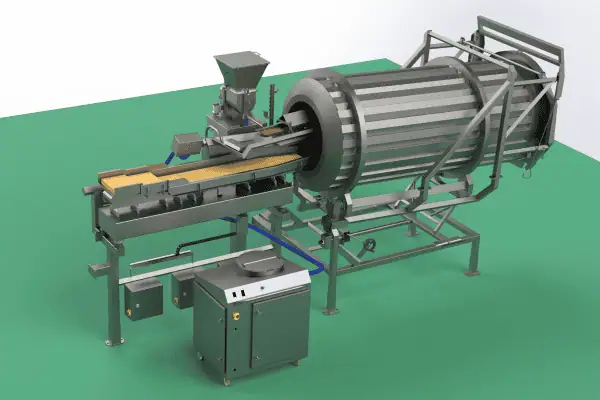
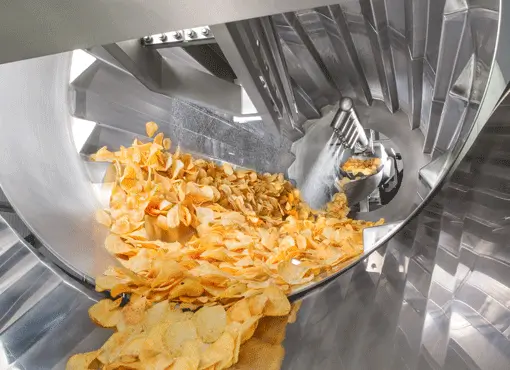
The seasoning drum itself plays a critical role. The internal geometry, the angle of inclination, the speed of rotation, and the length of the drum all affect how long the product stays inside and how evenly the seasoning is distributed across its surface.
A drum that is too short or running too fast will not give the seasoning enough time to adhere properly. One that is too long may cause product damage through excessive tumbling. Getting this balance right requires an understanding of the specific product being seasoned, its size, shape, weight, and surface texture.
Environmental Factors
Seasoning powders are sensitive to their environment. Humidity, temperature, and storage conditions all affect how well a powder flows through the dosing system and adheres to the product surface. In humid environments, powders can clump and bridge in the hopper, leading to inconsistent feed rates. In very dry conditions, static can cause seasoning to stick to equipment surfaces rather than the product.
Controlling the environment around the seasoning system, or choosing equipment that can compensate for these variables, is an important part of maintaining accuracy.
The Importance of Integration
Seasoning accuracy is not just about the drum or the doser in isolation. It is the result of how the entire system works together: the conveyor feeding the drum, the dosing unit, the drum itself, and the controls that tie them all together. When these components are designed and integrated as a single system, they can communicate and adjust in real time to maintain accuracy even as conditions change.
This is why a whole line approach, where the seasoning system is designed in the context of the full production line, consistently outperforms a setup where individual machines are bought separately and bolted together.
Practical Steps to Improve Accuracy
If you are looking to improve seasoning accuracy on your existing line, there are several areas worth reviewing. Start with the product flow into the drum. Is it consistent, or does it surge? Look at your dosing method. If you are using volumetric dosing and experiencing drift, a gravimetric upgrade may be the most impactful single change you can make.
Check the condition of your seasoning powder supply. Are there clumping issues? Is the hopper bridging? And finally, consider whether your controls are set up to allow the system to self correct. Modern control systems can monitor application rates in real time and adjust dosing automatically, but only if the equipment and sensors are in place to support it.